|
Bridges
|


|
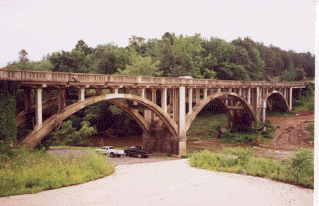
Located three miles north of Greenbrier, Arkansas
the Highway 65 bridge is one of the most important bridges crossing the North Fork of Cadron Creek. The bridge was constructed at Style Ford an important crossing for pioneers heading to Pinnacle Springs and the northern part of the state. This bridge served its purpose well for many years and withstood several floods, but was torn down following construction of a new four-lane bridge just south of this site. Nothing is left today of this once graceful bridge. |
|
Located north of Wooster, Arkansas this single-
lane wooden planked bridge was torn down following construction of a new concrete two-lane bridge just north of the site. Nothing is left today of this beautiful landmark that gave one caution whenever it was used to cross the North Fork of Cadron Creek. The bridge marks the end of Cadron Creek's whitewater and the start of the Bogaloosha. The Malletown Game and Fish Access Site lies on the south bank and Cadron Creek Outfitters offers shuttles to and from this access site. |
|
A patented bowstring bridge was built by the King Iron Bridge and Manufacturing Company in 1874 to
cross the lower Cadron Creek east of Springfield, Arkansas. With a 146 foot span it was one of the longest of its type and was included in the HAER registry as one of the Great American Bridges. Although considered to be one of the most beautiful bridges in the state it was recently torn down and replaced with a generic reinforced concrete bridge--a bridge that serves very few people. In fact the primary use of the new bridge is as a launch site for household trash which can be seen either deposited on the banks or floating on the Cadron Creek on its way to the Arkansas River. Unfortunately the state of Arkansas rarely enforces its anti-litter laws and Cadron Creek Outfitters already has its hands (and trucks) full keeping the upper stretches of Cadron Creek free of litter.
As an aside, the King Iron Bridge and Manufacturing Company enjoyed a national market, erecting
bridges from coast to coast during America's expansion West in the late 1800's and early 1900's. The King Iron Bridge and Manufacturing Company built over 5000 bridges before the company was disbanded in the 1920s. Few of these bridges still stand today--like the Springfield Bridge they have been torn down and replaced. Progress they say. |
|
Many years ago the waters of Cadron Creek served as a mode of transportation to move
logs, cotton, mealed corn and other products to distant markets. Today Cadron Creek is considered an impediment to transportation and many bridges have been constructed to span its water and connect highways meeting at its shores. Bridge building is a profession in itself, and some of the great bridges in the world are justly regarded as among the highest achievements of mechanical science and skill. Whereas many of the early bridges spanning Cadron Creek were simple structures, todays bridges of reinforced concrete are capable of bearing heavy loads and withstanding severe floods.
So as to appreciate the changes in bridge construction that have occurred over time--and
the loss of our heritage--we offer the following information on the bridges of Cadron Creek: |
|
THE HIGHWAY 65 BRIDGE
|
|
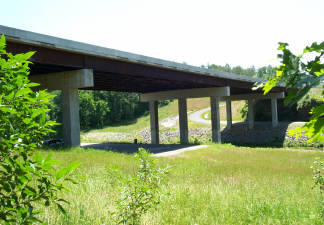
The new bridge is a reinforced concrete structure
that bears the weight of four lanes of traffic . The bridge echos the roar of large 18-wheel diesels and motor homes heading to the Ozarks and parts beyond--moving so fast as to not even notice that a lovely stream lies below. The Dippert Game and Fish Access Site is found just below the bridge and can be reached using the approach to old bridge on the north bank. The bridge shades the parking lot. Cadron Creek Outfitters offers shuttles to and from this access site and also helps maintain the grounds. |
|
THE WOOSTER (HIGHWAY 285) BRIDGE
|
|
THE SPRINGFIELD BRIDGE
|
|
MILL BRIDGE (Graffiti Bridge / Iron Bridge)
|
|
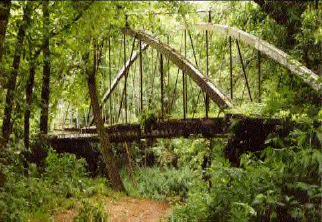
As you descend the steep. curved gravel road from North Guy, a view of hills, pastures and fence
posts seem to extend to infinity. Tucked in a bed of trees, the concealed Cadron might be miles away. But as the road straightens at the bottom of the hill, the creek begins to reveal itself. A high truss bridge, with heavy planks that rattle as vehicles cross, peeks through the river birches like a rusted skeleton. Tire tracks in the worn roadways and weedy fields and the stone enclosed circles of charred wood tell that others have been here before.... Both young and old swam, fished and picnicked here.... People still gather at the iron bridge to swim and fish, crowding its open banks on hot summer weekends and holidays. |
|
Lil Junas, Cadron Creek
|
|
Well times certainly change. Like all the other wooden bridges spanning Cadron Creek the old Mill
Bridge has been destroyed and replaced with a new concrete reinforced bridge. And you won't find anyone swimming and picnicking here today as the adjoining fields are fenced and posted "No Trespassing". Today the only visitors to Mill Bridge come under cover of darkness and the new bridge is commonly referred to as Graffiti Bridge due to the multi-colored messages that the nocturnal visitors leave behind.
The original bridge was built in 1912 so as to eliminate the hazardous fording of the creek by mule-
drawn wagons which bought corn and wheat to be ground at Hartwick Mill on the south bank. The mill--one of the largest in the area--was built in 1868 by "Uncle" Tubby Hartwick and was washed away in the flood of 1927. Remnants of the rock dam serving the mill can still be seen downstream from the current bridge. |
|
An adventure awaits....
|
|
CADRON CREEK OUTFITTERS
54 Cargile Lane
Greenbrier, Arkansas 72058
(501) 679-5050
www.cadroncreekoutfitters.com
|